Monday, 15 February 2016

Summary of Script Feedback from Christopher Johnson

  • The dialog is probably the main area that needs changing
  • Instead of having Stella say "I fee so fucking directionless" have her imply it in an analogy. Such as the Well analogy used in West Wing.
  • Try to apply the 'show don't tell' technique to your writing
  • REMINDER: 'Show don't tell' = enable the reader to experience the story through action, words, thoughts, senses, and feelings rather than through the author's exposition, summarisation, and description.
  • The narrative is kind of like a modern fable.

Monday, 28 December 2015

Analysis of a Comic Script (GHOST published by Dark Horse Comics)

Ghost is the fictional superhero of a comic book published by an American company called Dark Horse Comics. The character appeared in specials and monthly titles detailing the afterlife of Elisa Cameron and her search for the truth surrounding her (apparent) death. I have. Dark Horse Comics have released a sample script of Ghost online

Fig. 1.
One my first observations about this script is the extensive descriptions for each different scene. For example, the description of the first panel (see Fig. 1.) is very long, this could be because it is an establishing shot. The artists who have to visually recreate these scenes would obviously find it extremely helpful for the script to be as descriptive as possible so it can satisfy the writers and producers who have approved of the script and they would receive a product that they are expecting but this gives the artists very little creative freedom. This extensive establishing shot would also be useful for the backgrounds in other panels in the scene.


Fig. 2.
Character descriptions in comic scripts are very blunt and basic (see Fig. 2). In the second panel a character is described as "The man is wearing threadbare jeans, wrinkled and sagging on his thin form and notched with a belt obviously too large for him, and battered work boots". This description is essentially a list of all the traits the writer imagines for this character and putting them in list form is a basic way for the artist to recreate it allowing minimal variation from the writer imagination.

Fig. 3.
The format to comic scripts is quite different to scripts in the audio visual medium. Each page of the script describes the page in that actual comic it self, it is then divided in to descriptions of each panel. As shown in Fig. 3, the speech and caption is separate from the description of the panel. I am writing my script on Celtx, a free online script writing service and with Celtx you can write a script and it automatically puts your writing in to a script format. Recently, there was an update for comic scripts to be written on Celtx. When printing a comic script it pits in to the format of a table but it types in a similar format to a regular comic script.


Sources:


https://en.wikipedia.org/wiki/Ghost_(Dark_Horse_Comics) - This source was used to gain information about the comic Ghost as I have not read it myself.

Wednesday, 25 November 2015

TRANSITIONS with Scott McCloud

Understanding Comics by Scott McCloud, is an amazing book about the work that goes in to this visual medium. It includes chapters about transitions, comics through history, comics in other countries, art styles and how this story telling avenue has an affect on our minds. 


In the chapter titled "Blood in the Gutter" McCloud discusses the transitions between panels. He argues that there are six different types of transitions when telling a story in a comic. These are:
  1. Moment to Moment
  2. Action to Action
  3. Subject to Subject
  4. Scene to Scene
  5. Aspect to Aspect
  6. Non-Sequitur
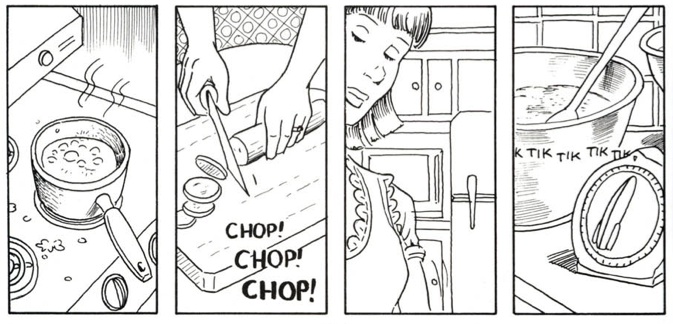
Fig.1 - Aspect to Aspect Transitions
McCloud shows that in a majority of American comics (such as Jack Kirby's Fantastic Four) uses transitions that are action to action based, whereas in Japanese comics (such as those of Osamu Tezuka) use drastically more aspect to aspect based transitions in comparison to America. Aspect to aspect transitions are used to establish a mood or a sense of place, it shows a moment at a standstill, frozen in time. In Fig. 1 we see a four panels establishing a kitchen scene. People can perceive and imagine this kitchen in just those four panels alone. McCloud talks about this idea of Closure, that we observe part of a scene within the fragments we are given but our minds are perceiving the whole it, we are filling in the blanks in the gutter. Fig. 1 gives us a high degree of Closure because we are taking these four fragments and constructing an entire environment so we get a real sense of this woman cooking. Aspect to aspect is very beautiful way of telling the story, because it places emphasis on being there in the narrative, not getting there.

If we chose to see stories as a series of connected events, then transition types 2 - 4 are perfect for that because the show things happening in concise and effective ways. Transition types 2 - 4 give us a more straightforward lens to the narrative. Action to action is the most commonly used transition because it uses less panels then any of the other transition types and when you have limited pages for an issue it is better to move the story than it is give appreciation to aesthetic (unless it is trying to emphasise a point). Movement to movement type transitions can be frequently replaced with action to action because you only need to show the first and last panel.